Notes from my reading of Photography in the Digital Age, by Geoffrey Batchen:
Photography started with death. People had to pose, unmoving, as if dead. In it's early days, it was used to commemorate the dead. Some feared photography would steal their life. Early photography struggled with life and death as photographs needed light to be seen, yet the same light also caused them to fade.
All photograph is a manipulation. Digital photograph is entirely fabricated, but even darkroom photography involves invention and manipulation. Yet it also carries the impression of its subject, as if the objects reached into the picture plane. The object, however manipulated, had to exist at one point to be photographed. Computerized images however can appear as photos yet never exist. Digital images are in time, but not of time. Photography, however, does not have to be threatened by the digital. Photography has always involved different techniques. As long as the human survives, human value and culture will also survive. The machine will always be guided by human desires. Photography's dilemma coincides with philosophers' ponderings: photography represents a reality but reality itself is comprised of representations. By challenging the death of photography, one must also challenge what it means to be dead or alive. Photography's passing will coincide with another way of seeing--and of being.
My own thoughts:
This essay was published in 1999, and since then, digital photography has exploded. As a photographer in a photo studio, what I see is an over saturation of photography in the market. Cell phones, laptops, tablets, MP3 players, and almost any electronic device seems to include a complimentary camera. "Prosumer" equipment is cheeper and more accessible to people. I wonder what Batchen makes of it. To me, I feel as if it will reach critical mass. After that, who can say? People are less likely to come to my studio for a family portrait, because even though I can take "better," more crisp and professional images, the sheer quantity of images parents have of their children on their iPhone makes up for the quality of image I can produce. I am not concerned about this however. I am an artist first, and a photographer second. I am an image maker, and photography is merely a tool. Just as the earliest humans made images in caves, the most futuristic humans will have images around them. I create things and will continue to do so until I die.
Monday, September 23, 2013

Monday, September 16, 2013
Mentor Meeting
I met with Julie Graham, my mentor, today. It was an excellent meeting. We discussed my most recent developments, and the possibilities for future development. This is the work I brought:


The first three were experiments I did with physical cutting. The first one, which is probably familiar by now, was done by cutting the illustration board. The middle two were done by cutting the transfer film first, and then transfer it. The middle two aren't as interesting to me at this point. It was a good experiment, but not worth too much more pursuing. Julie really enjoyed the top piece, and we talked about different shape to cut out, as well as the importance of imagery. It's kind of interesting to see the relationship of geometric and organic, but what does it mean? What am I trying to say? I told her how I began to see it as a digital map, and then we talked about maybe using an urban scene as the base image. Then we also talked about the grid being like perspective lines, and the black and white checkered floors used in Renaissance paintings, and that might be interesting to look for.
The bottom image is some model cycloramas I made. I simply pinned two pieces of foam core together to form a corner, and then attached the printed panoramas to the foam core, creating a soft curve.

The above image is one that, from a technical stand point, seems to be working well. Julie was impressed by the seamless blend of images, and it's one of the ones I'm happier with. The ones that Julie said she felt worked the best however were the ones that more thoroughly showed a morphing of indoor/outdoor space, like the one below:

When she mentioned that, I had to agree. These images are more imaginative, and not something you could find somewhere. Julie suggested looking for more locations with the architecture I'm interested in. She also brought up the idea of making the images perhaps even stranger, by incorporating more modern elements or other pieces that don't fit in this kind of romantic scene I'm making. This is something I feel is worth exploring. I recently finished the novel, A Hard Boiled Wonderland and the End of the World. It was suggested to me during the residency, and it was a fantastic book. It is set between two worlds: a familiar, yet somewhat futuristic version of our world; and an imagined world of a city with unicorns and no memories. One of the links between the two worlds is paperclips. This was an enjoyable link to me because it's so familiar, so common. Something like that, to link this world to my created world, might be interesting to see.
Friday, September 6, 2013
Digital Maps and Cycloramas

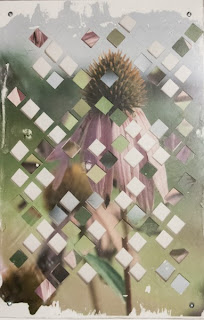
This image shows some of the progress I've made on that transfer I was working on. This picture is actually a little old now.Since this photo was taken, I now have cut a lot more squares out, and layered the piece between four pieces of plexi. I was thinking of work my mentor showed me by Steven Baris. He paints on plexi and uses shadows to contribute to the work. The shadows come into affect on this piece as well, in a pleasing way. I will do my best to get pictures of it soon. I am still working on securing the pieces of plexi together for display. One of the things I am enjoying about this piece is how the squares almost read like pixels, and makes me think of streams of digital information. When arranging the pieces, I think about maps, and layers of roadways.
I used to intern at a photo studio in Manchester, and recently the owner wrote a post about building a cyclorama. A cyclorama is used by primarily portrait photographers to create a rigid, seamless backdrop. The cyclorama has a subtle curve where the wall meets the floor, thus eliminating a seam. The few I've seen are usually white or black. When I was looking at the white cyclorama, I began thinking of what an interesting canvas that would be. Then I began to consider how one could create a space that would have depth but would not allow the viewer to fully enter.

As part of my own photographic practice, I often create panoramic images at different locations. I've been considering presenting these panoramas in a cyclorama form. I don't want them to represent an actually place, so I combined different panoramas to create a new world. It's world you can see, but cannot access.
Here are a couple still in progress:


I enjoy the one on the left more at this point because the pieces blend together more successfully. I ordered paper so I can print them somewhat larger. Eventually, if this idea continues to show potential, I would love to display them on a large scale, perhaps 8'x10', or something. If I used my transfer method, I could make the substrate for the print out of a variety of materials, enforcing the idea that this is a created space. Perhaps combining the cut pieces into this work would be interesting as well.
Tuesday, August 20, 2013
New Transfers
I had my first meeting with my mentor last week, and it went quite well. It's so helpful to be able to talk to someone about what I'm doing, and to get an objective view. I think I'm in a good place overall. I'm not entirely sure what I'm doing, but I'm not completely lost, thankfully!
One of the things my mentor recommended was to gather different materials and do some physical collaging, verses my usual practice of combing things digitally. I just did a transfer today onto illustration board. I have never used this process this way before. I knew it was a possibility, but I always just assumed if that's what I wanted, I could just stick a porous substrate through the printer. This affect is actually quite beautiful though. The pigments sit above the surface in a luminous way that I just love!
These photographs don't show the luminance, but the idea is there:

I also drew a grid pattern on the board before I preformed the transfer. My original plan was to cut out parts of this grid to layer with other images, but now I'm hesitating because I enjoy the surface so much. I'll go for it still though. I can always repeat the process if I prefer it.

One of the things my mentor recommended was to gather different materials and do some physical collaging, verses my usual practice of combing things digitally. I just did a transfer today onto illustration board. I have never used this process this way before. I knew it was a possibility, but I always just assumed if that's what I wanted, I could just stick a porous substrate through the printer. This affect is actually quite beautiful though. The pigments sit above the surface in a luminous way that I just love!
These photographs don't show the luminance, but the idea is there:

I also drew a grid pattern on the board before I preformed the transfer. My original plan was to cut out parts of this grid to layer with other images, but now I'm hesitating because I enjoy the surface so much. I'll go for it still though. I can always repeat the process if I prefer it.

Friday, August 2, 2013
Voyage to the Moon
It was kind of like an epiphany. The past month has been frustrating for me. I've been experimenting with different approaches to my art making, but nothing has been striking a cord, so to speak. I sat down with my laptop and decided just to put a couple things together. I almost immediately created an image I was excited by. In the past, the digital aspect has always driven my work, so it should be little surprise to me that I was suddenly struck with several different ways to present the image.


It's a definite step towards simplicity. Often my composite images are over fifteen layers, and this one is about three. I originally was thinking of using it for a large mirror I have. Then I began to think about doing the image on several pieces of glass to fragment it, and layer the glass over the mirror. I haven't made a decision yet. I'm considering the moon as a motif. It has appeared in my art several times. In this image in particular, it relates to the tides, and conveys the sense of change, of things being in flux, and showing a sense of time.

This is a second image that came together quickly. Usually, this is a good sign for me. Art that comes together quickly is more intuitive, and less overworked.
The moon also reminds me the 1902 film, Voyage to the Moon, which was referenced in the 2011film Hugo. Hugo is a narrative about a child who lives in a clock tower in Paris, and through a series of events, discovers his past is tied to that of the early French filmmaker and illusionist George Melies.
Saturday, July 27, 2013
Glass Painting
During the residency, one of my crits yielded the idea of accidental paintings. I've been contemplating this idea. I started painting on glass. I've done it before, but not with photography integrated into the process. I think the photographs are interesting, and might turn out to be the final product. We'll see. The tricky part about painting "through" the glass, is that as I apply the paint, I hide the view I'm looking at.


This first photograph is of a small transfer. I wanted to see if it communicated with the environment in an interesting way. Not as interesting as I hoped.

A practive piece of glass where I did a small study of transclucent acrylics (left) and oils (right) with colleged paper scraps.

Setting up to paint by looking through the glass. The set up worked better than expected.

A view of the painting in process.
Thursday, July 18, 2013
Little Sun
Artist Olafur Eliasson created this optimistic project about bringing light to people without electricity. I just watched a video interview here.
Another exciting discovery today was Berndnaut Smilde. He creates clouds inside of a room, and photographs serve to record the display. During an interview with Avant/Garde Diaries, he said about his own work:
"A lot of my work deals with the situation of duality: questioning inside and outside, temporality,
size and function of materials. I’m really interested in work that exits between reality and
representation in a way that it doesn’t really function in the end. So, as for the clouds, they’re just
there. They’re building up, at the same time they’re falling apart."
I find myself returning to this idea of the temporal, that nothing last forever and everything is in a constant state of change. I started overlapping images of clouds and water, things that fluid. It's not getting me where I want to be yet, but this idea of clouds...it intrigues me. You can watch them shift and change. Smilde's images are elegant and thought provoking and certainly had inspired me.
Another exciting discovery today was Berndnaut Smilde. He creates clouds inside of a room, and photographs serve to record the display. During an interview with Avant/Garde Diaries, he said about his own work:
"A lot of my work deals with the situation of duality: questioning inside and outside, temporality,
size and function of materials. I’m really interested in work that exits between reality and
representation in a way that it doesn’t really function in the end. So, as for the clouds, they’re just
there. They’re building up, at the same time they’re falling apart."
I find myself returning to this idea of the temporal, that nothing last forever and everything is in a constant state of change. I started overlapping images of clouds and water, things that fluid. It's not getting me where I want to be yet, but this idea of clouds...it intrigues me. You can watch them shift and change. Smilde's images are elegant and thought provoking and certainly had inspired me.
Subscribe to:
Posts (Atom)