Thursday, March 20, 2014

First Mentor Meeting

Karl Baden agreed to be my new mentor, and even managed to have a meeting with me this week. He made some astute observations that should help direct my work for the rest of the semester. He thought my current body of work is interesting, but he had two main concerns. The first concern was with how many of these type of images could I really do, assumedly before it becomes redundant. The second concern was the relationship this work has to Jerry Uelsmann and the risk of being clique. Both of these issues are things I have been somewhat aware of, but wasn't sure how to proceed.

Addressing these two points can help drive my work forward. I have been working with similar imagery from last semester, and while I enjoy the process, I have been wondering if these images brought anything new in terms of content or presentation. Karl suggested giving the images more complexity, such as through the presence multiple perspectives. A similar idea came up during the residency, but during this meeting, it was addressed much more specifically. Right now, these images all look in a very central direction. This has been mostly intentional on my part. I wanted the images to feel like places the viewer could actually enter, and this kind of perspective works well for that. It also is the way I intuitively photograph and simplifies the process of cohesively blending images. I see the value of deviating from this, however. I have been considering ways make the images more interesting and this seems like a logical place to start.

Below are two of my newest images I brought to our meeting, along with other images I've posted to this blog. The iamge on the right has been reworked from last semester to give in more depth and perspective. I have begun, for the moment, reconsidering images that I took in the past, rather than trying to find new things to photograph. The current snowy landscape can only offer so much and looking at my photo archive with new eyes was refreshing.


I showed Karl the study I did with the mirrors and reflected image and he brought up some artists who have worked with mirror installation successfully. Karl also pointed out how water seems to be important to my images. I often include water as a symbol for things being in a state of change, and to some extent, as something that erodes and causes change. I'm interested in emphasizing the temporal in my work. In order to avoid some of the borderline clique images, Karl suggested using actual water verses just photographic elements. This seems like a very intuitive direction and once he suggested it, I wondered why it hadn't occurred to me sooner. He recommended doing some tests with paper in water and I think this could yield some interesting results. The physical erosion of the image holds some potential. We looked at some work that Charles Ray did with oil (a Minimalist style cube filled with oil, and a jet of oil that looked like a thin line in the center of the gallery) as well as James Turrell, who uses light as a material, giving it a substance-like quality.

I seem to be moving towards the realm of installation, like a moth to a light. This direction surprises me but I also find it exciting. There is so much possibility. It was so valuable to have an outside look at my work. It can be hard to get the necessary clarity on my own. Sometimes I feel like I can't see the forest through the trees. This meeting was timely and refreshing.


Sunday, February 23, 2014

Reflections

My most recent piece is probably one of my strongest ones I made this semester. 


I tried some experiments with a small model set up with mirrors. My idea was a false-false image (a reflection of a fictional image).  I was inspired by a MoMA video with Isa Genzken, where she collaborated with a photographer. He made large, wall sized prints that reflected in large mirror wall sculptures by Genzken. 

The reflections caused a confusion of space, between what was image and what was reflection. I thought that was interesting. These are shots of my experiments:


There were 12 inches tall. If I were to actually make it, these would probably be 12-14 feet tall. It was interesting to try. I don't think I'll ultimately go this direction. Something that came up was that I realized I need a ground piece because it played in the reflections. The imagery was from one of my final pieces from last semester and I enjoyed reworking it into this new format.


Monday, February 10, 2014

Thoughts on New Work

It's been a slow start for me to start making new art this residency. I've made some of the suggested changes that were recommended during the January residency, but as for new work, nothing has completely clicked yet. I need more material to work with. I took several panoramics of the snow, which we have in abundance right now. Snow doesn't particularly inspire me. It can be a little difficult to photograph because of it's whiteness and possible glare, and the colors don't have the richness I enjoy. I did go up north this past weekend, and collected some image of the mountains and rivers while they were frozen, and visited an "ice castle" at a local ski lodge. Some of the results have possibilities:


The Ice Castle ones are interesting by themselves. I'm not sure how or if they would work in a montage.


These are a couple of my montage attempts so far. There's potential. I'm not sure about them. They're not hitting the mark yet. There isn't the strong sense of light that would bring make them alive. I might be able to work them over a little more to bring it out. The one on the left I fear is getting a little spider-like, and I wish I could make the chandlers look like they were swinging. I like it, but it needs something more. As for the snow castle piece, I like the sense of dusk, but I wonder about it feeling like Narnia too much. Also, when I had worked with my last mentor, we had talked about interior/exterior spaces, and the snow castle is all exterior.


For fun, to kind of shake things up, I tried this variation on the snow castle:


It seems like a popular design aesthetic right now to flatten shapes. Sometimes that trend appeals to me, but I don't see it as something I'll pursue, especially for the immediate. I'm more interested in naturalistic sense of depth, but I am interested in merging unexpected textures with architectural forms. It's simple in my sketchbook, but sometimes in the photo world, it's not right. It can get too busy or look forced.

My final thought for the night comes from looking at some of my panoramic source material from last semester. I saw three images from the same location next to each other in an interesting triptych.


It's too close to straight photography for me to work with comfortably. Too close to the facts to reveal the truth, or something like that, but they do seem to resonate. It reminds me of Noriko Furunishi's large photo collages. I like the proportion of scale and how the three work together even with different perspectives. Erik Johansson did a TED Talk and he said there were three main rules to photo manipulation: idea, same light, and same perspective. Obviously he speaking to a specific form of photo manipulation, but I feel inclined to not follow those rules.  His work is interesting, but borderlines on being shallow in my opinion. For example I love an image he has of a man laying down mirrors to reflect the city street he is on. Another image of him ironing the pants he is wearing however, feeling a little slap stick to me. I think that is the line I'm worried about, doing things because I can and being so involved in a technique that the content becomes less interesting. To have a sense of drama, but not to be like a Disney or Lord of the Rings movie. I'm not opposed to those impressions being present, but I don't want it to be simply entertaining and lacking depth.

One of the points of conversation I had during the January residency was about ruins, and a sense of decay. I've recently been reading some commentary on Romanticism and the movement's use of ruins. The sense of the organic, of decay appeals to me for similar reasons it appealed to the Romantics, and that is the idea that this is all temporal, and subject to change. I don't wish to be so heavy handed, but I've always had that tendency. I'm working on not needing to give the viewer everything. 

Saturday, February 1, 2014

Mike Kelley

I visited New York on Monday to see the Mike Kelley show at PS1. I'm glad I made it before it comes down on Sunday. The show was an enormous retrospective, and did an excellent job at showcasing Kelley's vast range of work.

I found several things interesting. The first piece catching my attention was perhaps one of his earliest pieces in the show. My Institution Meets Your Institution attempted to demonstrate the need to break down the barrier between high and low culture by incorporating drawing found at a museum's loading dock with signifiers of high culture. I found the red ribbon engaging as it lead to a battering ram that could supposedly be used to break down the down leading to the loading dock.


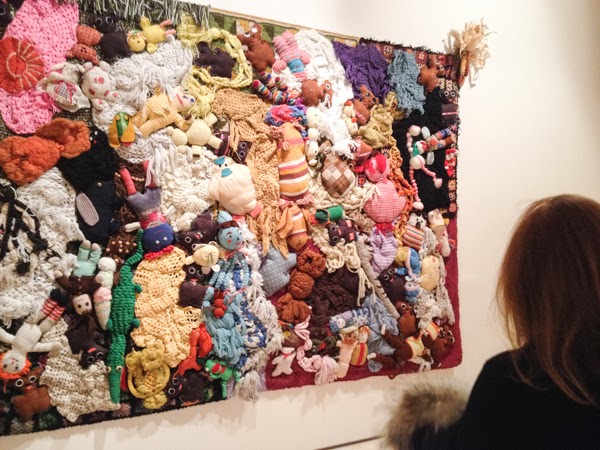
I previously knew of Mike Kelley's work involving stuffed animals, but these interested me much more seeing them in person. I participated in a guided tour after scoping out the work myself. It wasn't very enlightening, but the guide did elaborate on the piece, More Love Hours Than Can Ever Be Repaid. The guide said Kelley focused on the hours it took for each stuffed animal and afghan took to be made, and how the stuffed animals represented the love the maker felt towards the recipient, as well as the love the maker perhaps expected in return. When Kelley first displayed the work, however, many people felt it reflected a dramatic childhood event and that critique initiated a series of work on suppressed memory. It's quite fascinating to consider making a body of work based on the idea you forgot something.


His roll as a "youthful rebel" however, seems contrived. Sometimes, the work felt as though he tried too hard. He critiqued the system, perhaps, but he played by all their rules. When people suggested he had repressed childhood trauma, he made art about repressed childhood trauma. Even his piece, My Institution Meets Your Institution is meant to "break down the barrier" between high and low art, it still sits very much from the place of "high art" in terms of scale and presentation. The battering ram is nothing more than a prop, a symbolic gesture that fails to actually change the status quo. During the guided portion of my visit, the guide said Kelley longed for the "hippie" culture he missed out on, and I can see that evidenced in punk culture in general.

His latest work, the Kandor series, was much less appealing to me personally. I can appreciate the idea of protecting a home world, and the idea of never being able to return to where you grew up. The work felt too polished though. It felt more like misplaced movie set pieces, and I missed the visceral energy I felt in his earlier work, in particular the work with the stuffed animals. The part of the Kandor series I did enjoy were the cities that looked as if there were made of old bottles (as shown in the right image below). This more reflects on my personal aesthetic however, and my attraction to found objects as art.


The most inspiring part of the show for me was Educational Complex, and the large suspended stuffed animal balls. The idea of suspension creates a great visual and literal tension. It works well in Kelley's comic-like style, and I wonder about incorporating a similar technique in my own art. In Education Complex, it intrigued me to learn the original installation allowed for visitors to lie under neath the display and look up into. This seems like a very interesting way to view art. During our last residency, Angela Dufrane spoke of negative joy, and I can feel that same sentiment throughout Kelley's work. I left the show with the impression of a deep, underlying sadness. Overall, the show included a vast range of work and versatility amounting in an impressive showcase.


Monday, January 13, 2014

Residency 2

I just back from my second residency last night, and it's amazing to compare how different the experience was. The first residency was so overwhelming in so many ways, but at least for this one, I felt much more prepared for what I was getting into. Overall, people seemed to really understand my work in the ways I wanted them to. I feel like I'm in a good place, while knowing there is always room to develop. 

These are some pictures of my work in my display space during the residency:


As you can see, I brought one very large print (second image). Sometimes I jump into something and don't realize exactly what I've gotten into until it's too late. This print ended up being 6x21 feet. It was printed in three segments, which I then taped together. It took 6 hours to complete printing, and 4 hours to assemble. Due to weather, our first day was cancelled and I ended up assembling these three pieces in my hotel room. This involved a scrolling kind of technique, as shown below:


Originally, I planned to display this piece with the lower portion flat on the floor (similar to how the first image is, though the lower portion would extend much further). My thought was that it would really give the viewer the impression they could actually enter the space. When I was assembling it, however, and saw the lush curves of the paper, I felt I wanted to display it this way, with the paper rippled. I presented it both ways, and most of my critiques reinforced that this curved way was a good decision, making the piece more of an object and adding to the surreal illusion. Ideally, I would display all of the images in this sort of format, but for practical reason, I brought the rest of the work in smaller forms.

Wednesday, December 18, 2013

Final Thoughts

It's hard to believe I had my last meeting with Julie Graham, my mentor, a week ago. I know this post is slightly delayed-my laptop has been in the shop due to a Wifi issue, much to my frustration, but is better now! This semester has flown by! I feel like Julie and I have connected well during the last few times we met. It's sad to know we won't be meeting as regularly now, though I am hoping to keep in touch! I brought several work prints for us to talk about, and our conversations were quite insightful. One of the things I appreciate most about Julie is that she asks the right questions. She knows how to probe and help me realize what exactly I'm trying to say. These first two were more to demonstrate that I'm trying different things. Neither of them are complete, but both have aspects that are interesting.


This next one I labored over for such a long time! I feel in conveys the right mood and setting. I wonder about extremely long format. (I might rework it a little to shorten it. I haven't decided if that's entirely necessary.)


This last one is my most recent, and perhaps even the most interesting. I am really pleased where I got with it.

Julie was also very intrigued by this one. She suggested the crop I have here, with the top edge flush with the frame of the window ( We also talked about cropping the upper corners, which I plan to do in the final presentation.). She also suggested centering the carousel. There were a couple technical points I have to look at closer before the final prints, but that's the point of work prints--to see what needs adjusting. The nature of this style is that it requires a high degree of nitpicking. I enjoy it though. It satisfies a certain degree of obsessive compulsiveness I possess. 

As we spoke, Julie asked about my interest in history. I lean heavily towards this specific historical architecture, and she wondered about the purpose of that. I know I find it interesting. So far, many of the buildings have been libraries or churches. It reminds me of the Age of Enlightenment, and these grand intentions our ancestors had. I wonder what they would think of these spaces now, often occupied by the homeless. The cathedrals, similarly built to convey the very presence of God, yet now are mostly empty, save the tourists. The ideals are gone, but the buildings remain.

We began to talk about history and historical references I seem to make in my work. It's interesting that these reference are still there. In my original body of work I brought into the program, I was very interested in places having layers of history we can't see. I think about time traveling in circles, where things seem to reoccur throughout history. The idea of myths came up in our discussion as well, and I mentioned my interest in anthropology during my BFA studies. Perhaps there is something worth pursuing in this.

I left the meeting feeling much more confident in my intentions and content from this series of work. I feel a surge of nerves in anticipation for the upcoming residency. It will be interesting to hear what sort of feedback I receive.

Sunday, December 1, 2013

"Poetic Faith"

Recently, when I was contemplating my art and my motivation, I felt strongly that I wanted the spaces I have been creating to be empty of people. It seemed appropriate that the viewer could feel this sense of taking a journey, embarking on an adventure, and going to a vacant place. I recently wrote a paper about the suspension of disbelief, in photography specifically, and a came across a quote that said the viewer must have "poetic faith." That phrase is appealing to me, and I began to think about faith being a step you can only take alone. I know that regardless of the support I have when making a decision, it ultimately is on me to take the step, and belief it will be alright. We associate other people with security and safety, so to wander into a place without other people presents a certain risk. This is the edge I hope to explore farther.